Today is primary day and 3.5 million Flori

Showing posts with label independent movement. Show all posts

Friday, April 08, 2011

REVIEW: Independence and Talk Talk About the Talk of Talking Heads


Review
Edited by John Opdyke

Review by Todd Neff

I once covered local politics as a newspaper reporter in Boulder, Colorado. I felt I understood Democrats. Broadly speaking, they seemed to make decisions based on some semblance of what my five senses construed as reality, with a degree of humility, and with at least some empathy for the nonrich, not-environmentally destructive, nonfundamentalist masses. I thought I understood modern Republicans, a self-certain lot who seemed to make decisions unburdened by such empathy, based on a worldview so pixilated as to seem otherworldly.

I had no clue about independents. I mean, an independence movement seemed inimical to the idea of a movement in the first place. Michael Bloomberg’s rationality notwithstanding, a bunch of independent ideas assembled into a movement would regurgitate a mess of helter-skelter policy, right? The book Talk/Talk has helped set me straight.

Talk/Talk is a very different concoction, as books go. It’s a compilation of talking heads talking about the talk of talking heads they (that is, the talking heads featured in Talk/Talk) watched on Sunday TV talk shows. Independence movement leaders Jacqueline Salit and Fred Newman are the stars of this 170-page show, which proceeds in dialogue format, as in:

Newman: What we’ve said before and will say again: that independents are able to shape positions which come closer to where the people are. Democrats and Republicans who are party loyalists can’t easily do that. They can’t do that because their loyalty is fundamentally party loyalty.

That’s on page 45, the beginning of Salit and Newman’s discourse on “This Week with George Stephanopolous” of Sunday, July 8, 2007. The shows they watch change, and the dates and topics leap back and forth with pleasant randomness. There is no central message, no polemic. You realize, as you read through conversations on topics as diverse as the Diagnostic and Statistical Manual of Mental Disorders and the applicability of Henry Kissinger’s power politics to the modern world, that being independent is mostly about thinking, and that Salit and Newman are well practiced at the art.

Closing the book, I had a sense that, perhaps, the independence movement is actually about policy-making on a rational basis, based on a will to deliver the greatest good for the citizenry – and not, as is the case with today’s political parties, warped by the pressures of self-serving lobbies from the left or right.

I’ll close with Newman’s words, spoken after a PBS News Hour on December 14, 2008. In the wake of the catastrophe in northern Japan and in the face of our own unfolding policy disaster courtesy of party politics, they resonate.

“There is something fundamentally tragic about our lives, all our lives. . . We’re up against forces which we’re thought to be smarter than and more powerful than, but which, in fact, we’re not smarter or more powerful than at all,” Newman said. “That’s our tragedy. We, meaning human beings, believe we are supposed to be in control – of nature, of the world. But we’re not, as we’re discovering. Can we do things better? Yes. Do we? Sometimes.”

Todd Neff is a Denver journalist and author of “From Jars to the Stars: How Ball Came to Build a Comet-Hunting Machine.

Wednesday, April 29, 2009

Politics for the People Lecture: Dr. Omar Ali


"A Brief History of How Independents Have Expanded American Democracy: The Tensions, Turmoil, and Triumphs of Movement-Building"

Saturday, May 9, 2009
2:30 P.M. - 4:00 P.M.
New York County Lawyers' Association

Dr. Ali is a visiting professor of history at Vanderbilt University and the author of In the Balance of Power: Independent Black Politics.and Third-Party Movements in the United States.

From 1776 to the election of Barack Obama, political independents have been on the cutting edge of the American democratic experiment and are responsible for many of the small events that brought about big changes.

On Saturday, May 9th, join Cathy Stewart and special guest Dr. Omar Ali, professor of history at Vanderbilt University and author of In the Balance of Power: Independent Black Politics and Third-Party movements in the United States for a thought provoking conversation about the role of independents in the development of our country... and the impact we are having in reshaping contemporary politics.

SATURDAY, MAY 92:30 P.M. - 4:00 P.M.
Followed by a book signing with Dr. Ali
New York County Lawyers' Association
Main Auditorium14 Vesey Street
(Between Broadway and Church St.)
New York, NY 10007

Directions:Subway: A,C,E to World Trade Center; N, R, W to City Hall; 2, 3 to ParkPlace; 4, 5 to Fulton Street; M to Fulton StreetBus: M1, M6, M9, M15, M22, M103 to CityHall/Fulton Street area
Seating limited.
Please R.S.V.P. at 212.962.1699
PLEASE BRING A FRIEND!!

Monday, March 30, 2009

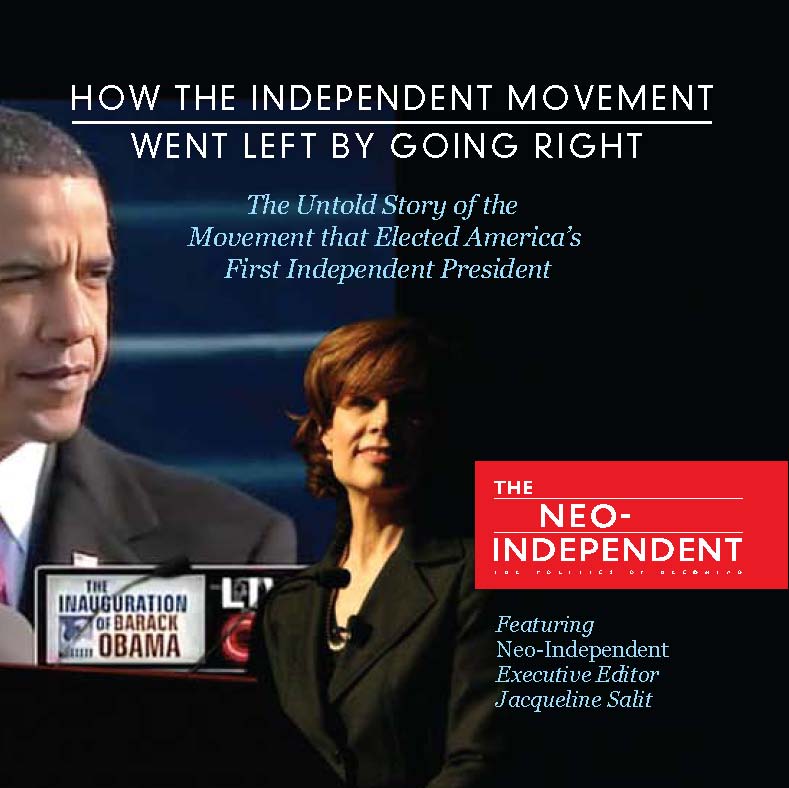
Jackie Salit: How the Independent Movement Went Left by Going Right


How the Independent Movement Went Left by Going Right


As commentator John McLaughlin remarked, "It's the independents who are controlling the action.  You can't understand what happened on Election Day if you just look at the [two] parties.  You've got to look at what happened with independents."  

    Now, Neo-Independent magazine editor and IndependentVoting.org founder Jacqueline Salit presents that history.
 
     HOW THE INDEPENDENT MOVEMENT WENT LEFT BY GOING RIGHT goes behind the headlines to consider the strategic alliances, innovative tactics and on-the-ground organizing that positioned the independent movement as a mainstream force for political development.
 
     Salit offers key insights into the changing character of the American political process - examining efforts to integrate the Perot movement, the significance of open primaries, and the vital connection between small, qualitative developments and sweeping social change.
 
     HOW THE INDEPENDENT MOVEMENT WENT LEFT BY GOING RIGHT is an important, untold story about how we, the America people, built a movement that challenges the culture of partisanship.


Reviews

 
"A comprehensive overview of the impact of the independent movement on the Obama election."
 
- Douglas Schoen 
 Political Strategist 
 

Info
 

Watch the Preview
 
DVD disc face
Jacqueline Salit paints a vivid picture of a fluid but pivotal movement that broke into the mainstream in 1992 in the explosive center-right campaign of Ross Perot. In her dual role of political player and analyst, she documents its evolution over the next 16 years into a center-left, multi-racial movement that changed the rules of engagement in 2008. 
 

Friday, November 14, 2008

TODAY'S NEWS HEADLINES for INDEPENDENT VOTERS

POST-ELECTION
  • Vast Obama network becomes a political football-Some Obama advisors want to blend his campaign operation with the Democratic National Committee. Others worry that such a move could cause the grass-roots organization to unravel. (LA Times) "A lot of these warriors on the ground are not Democrats, and that's by choice," Figueroa said.
  • Obama carries precincts in traditionally Republican Inland region by substantial margins (Press Enterprise - southern CA) The results suggest that many of the region's increasing number of independent voters -- those who decline to state a party affiliation -- went for Obama.
  • America Throws Long - If Obama doesn't connect, more than the game is lost. (By PEGGY NOONAN, Wall Street Journal) Does it mark the beginning of a center-left era? That's the kind of thing you know in retrospect. The vote will prove to be a realigning one if Mr. Obama does well enough over a long enough period that people come to see themselves not as voters who picked him but as people who are his followers. If they choose to follow him, their self-identification as Democrats will sink in and formalize, and the vote they cast in 2008 will come to seem not a decision but an affiliation. Without affiliation, everything remains in play and will be in play in the coming years. If Mr. Obama doesn't catch the pass and cross the goal line, it will mean this election marked a moment, not a movement.
  • Lurching center-left (Washington Times) It is now abundantly clear that America is a center-left nation, and healthy majorities of the American people agree with Mr. Obama's liberal economic policies.
  • OR: A blue election tide -- or a white one? (The Oregonian/The Stump) While the rest of the nation celebrates a transformational election that couldn't have taken place without minorities in general and Barack Obama in particular gaining access to political power, the Oregon Legislature will convene in 2009 as the least diverse it's been in decades.

Thursday, March 06, 2008

Fulani: How Nader Has Made Himself Irrelevant

Ralph Nader seems to equate himself with the independent political movement and to define it relative to his positions, his aspirations and his critiques of the two-party system. In this way Nader has fallen out of step with the independent movement.... (Lenora Fulani, The Daily Voice)

Sunday, March 18, 2007

Talk/Talk: An independent left of some significance

From last Sunday's Talk/Talk "Topsy-Turvey Times" with Jackie Salit and Fred Newman:
Salit: And, the independent movement is moving left…
Newman: At least it’s being pushed to the left by a force that is becoming more formidable. The independent movement was born on the right. But it was re-shaped by the war and by the forces that have been developing it on the ground, most specifically the activist independents in the CUIP network. In effect, you now have an independent left of some significance in this country....