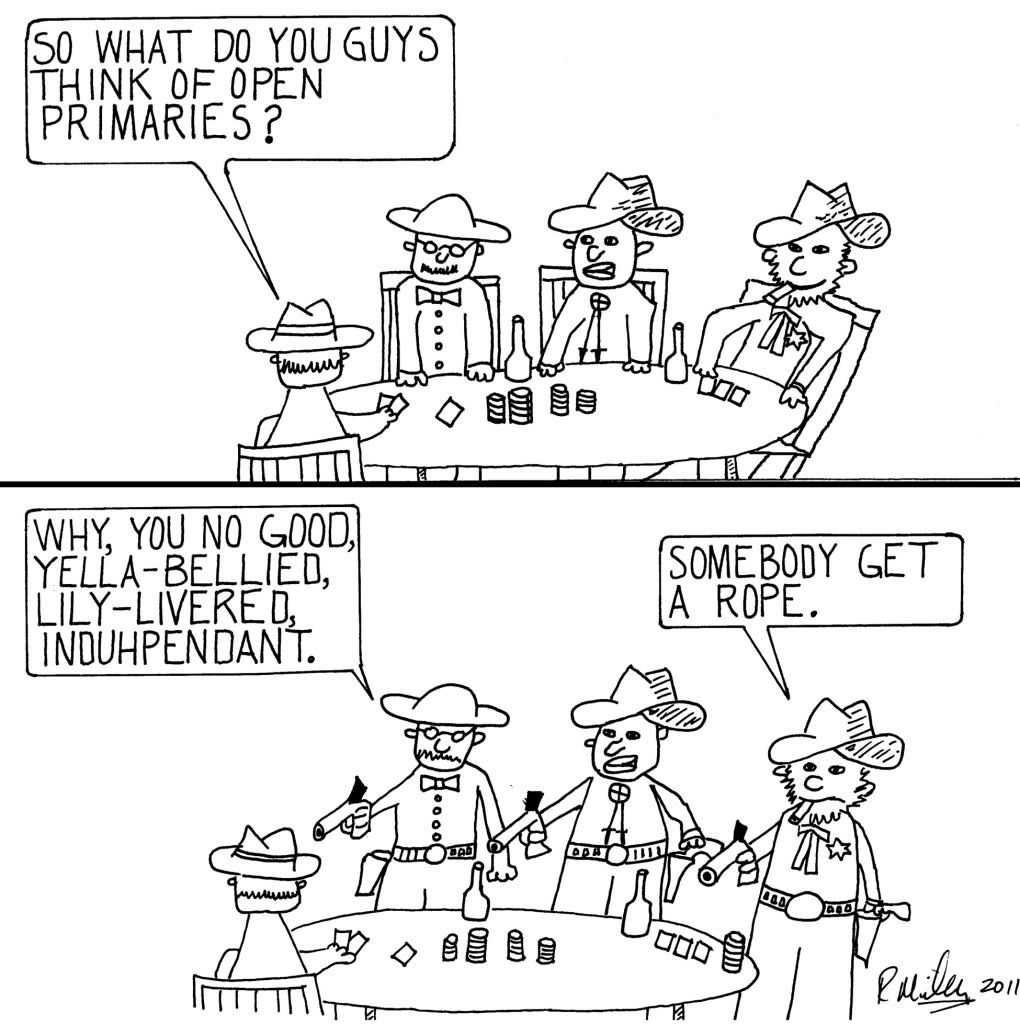
Today is primary day and 3.5 million Flori

Showing posts with label independents. Show all posts

Tuesday, August 06, 2013

Mas sobre los pasos tomar para tener un Alcalde Independiente.

Comenzamos hacer llamadas a todas esas personas que quieren  estar envuelta en esta fabulosa campana.


Josephine Coskie , tremenda voluntaria, una maestra haciendo llamadas a las personas de Queens

David Belmont otro Fabuloso voluntario tambien haciendo llamadas en agradecimiento de todos ellos que firmaron

Monday, April 23, 2012

Live Blogging Jackie Salit's National Confrerence Call for Independent Voters

Tuned in early tonight for Jackie Salit's conference call, featuring Mickey Edwards --

One of my favorite parts of these every six-week calls is the roll call. So many activists, so many states!!!

Intro by Nancy Ross,

Mickey Edwards, author of The Parties vs The People, How to Turn Democrats and Republicans into Americans, guest.

JS -- magnetic title, represented Oklahoma in Congress, speaks out about partisanship. Met at 225 Broadway at the CUIP offices, kindred.

So welcome to Mickey Edwards!

ME -- thanks

JS -- Provocative question: you have said that Americans have tried to take back their government but have not succeeded in using elections to do that.

ME -- We elect some group over another, doesn't work... I believe in the market system, not about the candidates, not about the voters, however -- closed primary primaries, when the candidates run for office, they are not thinking of the larger picture; focused on the narrow subset of primary voters.

We need broader choices. Only in our elections do we see private clubs proscribing our choices. Open market. Completely anti-democratic. Parties: take it or leave it! I just couldn't stand it anymore!

JS -- tell us about your experience in Congress. Share why you decided to run for Cong and what happened when you got there?

ME -- I had a vision when I ran. Belonged to a political party, but when I got elected, I crossed a magic line, supposed to represent the people. However everything was straight part line in voting within the Congress. Not sitting as Americans deciding theses issues. Was involved in committee negotiations. Members commit to party line before the vote. Party leaders run the process. That bothered me. Another example, redistricting -- Jackie, I'm a Republican -- won in a Democratic district. They redistricted me. Oklahoma City district was cut way up to Kansas and over to Arkansas. Looked at the Constitution. Constituents need to know the representative.... I'm from the City, don't know much about farmers and ranchers, their representation was not there, however it somehow benefited the party in power.

And by the way, nobody said in our governmental structure that reps should be divided according to "aisles" according to party.

JS -- The rigidity of the political system that hurts us -- winner take all. What do you say to people who say that that kind of rigidity is necessary for our kind of political system?

ME -- Yes, that works for prior systems, however, our Founding Fathers decided we wanted a citizen-directed form of government. Parliamentary systems are very easy to measure. But we rejected that form. We wanted a system of representation that speaks for the actual people in the districts.

JS -- Mickey, was it hard (emotionally) to write this, to take this position?

ME -- (chuckles) Frankly I was angry. How could it happen that people have all these experiences and yet we are locked into a party that tells us we have to do this or that on behalf of the party.

JS -- Many people on the call probably believe that open primaries would make a difference, Open Primaries Top Two won in California...

ME -- The primary system was progressive, democratic in the beginning, but the people in California and Washington State proved that we can change this. However, the Speaker of the House doesn't have to be a party leader. Look at Canada. You could have Colin Powell be the Speaker of the House. Or you could have the Speaker get 60 percent of the House.

Why do you have Speaker staff Dems and Repubs issuing policy papers?

JS -- 40% of Americans consider themselves independent, what do you think about the influence of independents?

ME -- The revolution is already underway! When Scott Brown got elected, people said, how did that happen in a Dem state? Well, because of the independents.

It's a matter of confrontation! Get people together to demand whatever you need and. This is about private clubs. That's what the parties are.

When I was in office, I had a lot of town meetings where I was confronted with voters who refused to accept a partisan excuse.

JS -- What do you think about Barack Obama and his independent coalition that won the White House, gets there and is faced with the partisan trap? What does he say?

ME -- He wanted to govern as a non-partisan, but misunderstood the partisan system. He proposed things that you might be able to forge a compromise around. But Nancy Pelosi said no -- WE won the election, here's the agenda.... [talks about talking with students about separation of powers - executive, legislative, judicial...] His heart was in the right place, but he misread the partisan politics of the job.

JS -- Yes, that provides insight to what's happening, and to the American people, and to The President: I love that you used "Parties vs. The People" -- your message really speaks to the sentiment of independents and the independent movement.


Thursday, January 12, 2012

Election Reform 2012: Virginia Loyalty Oaths, Partisan Redistricting Damage to Democracy, No Confidence in Congress, Rise of Independents


ELECTION REFORM DIGEST
Wednesday, January 4, 2012

VIRGINIA LOYALTY OATH IN PRIMARY
  • Va. GOP will require loyalty oath in presidential primary (Andrew Cain, 12/29/11, Richmond Times Dispatch) Anyone who wants to vote must sign a form at the polling place pledging to support the eventual Republican nominee for president. Anyone who refuses to sign will be barred from voting in the primary. During a brief meeting Wednesday at the state Capitol, the State Board of Elections voted 3-0 to approve three forms developed by the election board's staff to implement the loyalty pledge requested by the state GOP.
  • Virginia Republicans to require loyalty oath for primary voters (By Ben Pershing, Washington Post/ Virginia Politics) The pledge has no legal weight — voters are free to sign the form and then disregard it if they choose — but it is meant to discourage mischief-making by non-Republicans. Virginians do not register to vote by party, making it possible for Democrats and independents to show up and vote in the Republican contest.

REDISTRICTING
  • Partisan redistricting damaging to democracy (LETTER Asbury Park Press) There should be a national election law that makes each congressional district in that state reflect the partisan makeup of that state. If a state has 35 percent Republicans, 25 percent Democrats and 40 percent independents, then that’s how the congressional seats should be determined.
  • Lerner: Providing a fair alternative (By SUSAN LERNER, executive director of Common Cause/NY, Newsday) We are excited to work with Newsday to give New Yorkers the chance to participate in the redistricting process, by giving them a starting point to design their own fair, nonpartisan district maps for the Assembly, State Senate and House through the new, interactive UMAPNY website.
  • Redistricting battles to continue in new year (By Josh Lederman, The Hill/ Ballot Box) New Jersey came in just under the wire, with a bipartisan panel picking a Republican-drawn map two days before Christmas that will likely pit Reps. Steve Rothman (D) and Scott Garrett (R) against each other. * Democrats in Ohio gave up their challenge in December to a GOP-friendly map that had prompted complaints against both parties. Democrats accused House Speaker John Boehner (R-Ohio) of putting his thumb on the lever, but also faulted national Democrats for failing to intervene and help out in their fight. * And a bloody redistricting tug-of-war in Arizona between Republicans and the state's independent commission seems to have fizzled out after the GOP, led by Gov. Jan Brewer (R-Ariz.), ran out of feasible options for contesting a map that Republicans charge unfairly benefits Democrats.
  • Federal judges block West Virginia redistricting (By Steven Allen Adams, Reuters) The panel said in a two-to-one decision that the plan drawn up by the state's Democratic-led legislature, which left West Virginia's three congressional districts virtually unchanged, did not provide equal representation in each district… In West Virginia, the court said the legislature had focused too much on maintaining the status quo rather than making each district as equal in population as possible. It gave the legislature until January 17 to submit an interim plan or said the panel would choose its own plan.

FRUSTRATION WITH CONGRESS
  • Frustration with Congress Could Hurt Republican Incumbents - GOP Base Critical of Party's Washington Leadership (Pew Research Center report December 15) Independents, who have expressed great frustration with Washington gridlock over the course of the past year, are particularly critical of the Republican Party. By a 54% to 30% margin they say the Republican Party, not the Democratic Party, is more extreme in its positions, and they are twice as likely to label the Republicans than the Democrats as the less honest and ethical party (42% vs. 21%). Yet independents have few positive things to say about the Democratic Party either. Both parties’ leaders get poor approval ratings from independents (14% approve of GOP leaders in Congress, 23% of Democratic leaders). And when independents are asked which party can best handle the most important problem facing the nation, as many volunteer “neither” as say the Democrats or the Republicans.

RISE OF INDEPENDENTS
  • Voters leaving Republican, Democratic parties in droves (By Richard Wolf, USA TODAY) A USA TODAY analysis of state voter registration statistics shows registered Democrats declined in 25 of the 28 states that register voters by party. Republicans dipped in 21 states, while independents increased in 18 states. The trend is acute in states that are key to next year's presidential race. In the eight swing states that register voters by party, Democrats' registration is down by 800,000 and Republicans' by 350,000. Independents have gained 325,000.
  • California State Judge Expedites Hearing in Minor Party Lawsuit Against Top-Two System (Ballot Access News) The California Superior Court Judge who is hearing Rubin v Bowen has set a hearing date of February 7, 2012, for Rubin v Bowen, RG11-605-301, Alameda County.

Saturday, November 12, 2011

OneMaine

Those of you who know me personally or have read enough of my writing know that I am nothing if not fiercely independent.  That means that not only do I not always vote for one party in elections, it also means that I strongly support maintaining my right to be independent, not affiliated with any political party; therefore, not having pressure from my chosen party to go along with something I disagree with.
Sometimes I find it important to vote for Independents to make a point, although usually I vote for Independents because I believe in what they stand for, and always support issues that make it easier for independents to get involved in politics or make it easier for all of us to vote, such as open primaries.
Aside from voting for an Independent, it can often be difficult for an independent like myself to find organizations to support who stand for the same things.  Well, there is an organization now here in Maine called OneMaine, founded and chaired by Eliot Cutler, who you'll remember I wrote about and supported during his run for Governor last year (very nearly winning and becoming our third Independent Governor).  He founded this organization to attempt to bring under one roof all the people in Maine who are of like mind about having less partisanship and more cooperation in our politics for the benefit of the people of Maine.  From the OneMaine website:
OneMaine provides a rallying point for people who think for themselves, who believe that our politics need to be more effective and less partisan, and who care less about parties and more about common interests and shared purpose. We are not a political party, but rather a big tent in which Mainers of all stripes – Democrats, Republicans, Greens and unenrolled, independent voters – can collaborate, share ideas and move Maine forward.
Mr. Cutler helped establish this organization following last year's gubernatorial election to try to take advantage of the independent momentum of that campaign and to provide a place for disparate people with a common goal of the best interests of Mainers.
I would encourage you to support OneMaine (you can start at the link above or like them on Facebook) or to look for like organizations if you live outside of Maine.  There are many of you out there like myself who have always been independent and have looked for a place to get involved without joining a party.  Now you have that place.
The other day I sent an email to OneMaine asking if they'd be so kind as to give me a progress update on OneMaine that I could share with you.  Kaitlin LaCasse, the media relations director, was gracious enough to get right back to me with the following:
"So far, the response to OneMaine has been fantastic. When we launched in Bangor a few months ago, over 75 people attended to learn more about OneMaine and to have a conversation about how to best move the organization forward. Since then, we've held events all around the state, and the enthusiasm for OneMaine continues to amaze me. At our Portland event (where there were over 100 people!), an older gentleman came up to me after and said, "thank you, I've been yearning for something like this." The best part is that the man hadn't ever connected with us before - he had read about the event in the paper and decided to come check it out! So, OneMaine continues to grow and mature and we're excited about the potential."
 Thank you!
 Kaitlin
 Cross-posted at Inside Zebster

Buddy Roemer Reaches out to Occupy Wall Street


OCCUPY WALL STREET
  • Rabble in Arms (By Keith Kreitman, Daily Journal - San Mateo CA) Meanwhile, as I have written before, the candidates for the Republican nomination for the presidency march along from debate to debate, not recognizing and addressing the growing middle class dissent in the land they wish to rule, ignoring the Occupy movement and clueless that, with their ever more extreme programs that gain them love and kisses from their slivers of extreme right admirers, they are alienating more and more of the moderate middle class and independent voters and the Occupy movement will eventually rule. 
  • Mulling Third Party Bid, Buddy Roemer Reaches Out to Occupy Wall Street (By: Kevin Derby, Sunshine State News) As their candidate’s path to the Republican nomination becomes increasingly difficult, this week the Roemer camp threw out signs that he is considering launching a third party or independent bid for the White House.

Thursday, August 18, 2011

Why Independents Should Demand Internet Voting


What is an "Independent"? Lots of people are asking that question these days. Are Independents conservative or liberal? Are they closet Dems or closet Repubs? Are they more focused on public finance issues than on social issues? Are they moderates, or centrists? Is there such a thing as a political center in the US?

One empirical element shared by Independent identifiers is that they don't identify with either of the two major political parties, which currently dominate US elections and government. In this sense, Independents are not only alienated from the political system, they are excluded from it. They are not just passively unrepresented in our "representative government," they are deliberately ignored by our elected representatives. That is, of course, until those elected officials need their votes in the next two-party system election.

Thanks to modern electronic technology, this need not be.

Imagine this: You are watching candidates debate online or on TV. After each debate you log on to your state's secure voting website, using your own PC, cell phone, or other electronic device. Your voter registration is checked, and then the voting window comes up. You enter your rating of each debater's performance, from 0-9.

Suppose further that entry to the debates is open to everyone who wants to be considered by the voters, and that all candidates are eliminated through a series of such debates. Qualification for candidacy can be as it is now in states like California; i.e., fulfill the signature requirements, pay a filing fee, and you are on the ballot and in the debates.

In this scenario, it is the political parties that are excluded from the candidate selection and election process. Suppose there are a dozen candidates for an office. Two one hour debates can be held per evening. In three evenings all twelve can be heard, considered, and voted on by the electorate. The next week a final debate can be held between the top two, so that the candidate is supported by a majority of the voters.

Here is an election process that can be used for all local, state, and federal offices, with only minor changes in state laws. No constitutional amendment is required. Ballot access is 100% nonpartisan – an Independent's Heaven, right here on Earth. Because no self-serving political party will control the process, the locus of power will move to where it should be in a democracy – to the center of voter preferences.

This picture can become reality by demanding that your state government, state Secretary of State, and local election officials implement an Internet voting system organized along the lines I have suggested. In consideration for their sacrifices and service, you can also demand Internet voting for your state's overseas military personnel. (For more on that, and the opposition to it, see my post on Natalie Tennant here on The Hankster, at http://bit.ly/o65o1t, and cited on Rick Hasen's Election Law Blog, at http://electionlawblog.org/?cat=49 Also see the new "tough love" review of my book, Internet Voting Now! at http://is.gd/Sc5vch )


William J. Kelleher, Ph.D.
Internetvoting@gmail.com
Blog: http://tinyurl.com/IV4All
Face Book: http://tinyurl.com/BillonFB
Twitter: wjkno1
Internet Voting Explained on
YouTube: http://www.youtube.com/user/WJKPhD


Wednesday, June 08, 2011

Gov Cuomo: "Indies Don't Exist" Ha Ha!

INDEPENDENT VOTERS
  • New Law on Ethics May Face Challenge (By JACOB GERSHMAN, Wall Street Journal) By enshrining into law the perpetual dominance of Republicans and Democrats in overseeing ethics codes, Mr. Cuomo and lawmakers could be infringing on the rights of unaffiliated and minor-party citizens… There are about eight million active registered Democrats and Republicans in New York. An additional two million voters aren't enrolled with a particular party, while several hundred thousand are members of minor groups, such as the Conservative Party and Working Families Party.
  • Fred Thiele: Above the law? (by Jimmy Vielkind, Albany Times Union/Capitol Confidential) But there is currently one lawmaker who is an enrolled Independence Party member: Fred Thiele, of Suffolk County, a Republican turned Independent who now caucuses with the majority Demcorats.
  • POLL: Obama Has Some Work To Do With Independents (Richard Kreitner, Business Insider) The president's re-election ultimately hinges on whether he can secure roughly 50% of self-described "independent" voters. The Washington Post/ABC News Poll indicates that it won't be easy.
  • Obama’s approval gains among young and independents disappear (By Scott Clement, Washington Post/Post Politics)
INDEPENDENT REDISTRICTING
Dan Walters: New California legislative maps make good on promise of reform (By Dan Walters, Modesto Bee) An increase in swing districts would mean that right-wing Republicans and left-wing Democrats would no longer be assured of winning seats after nomination. The state's new "top-two" primary system would, at least in theory, also work against ideological rigidity. Together, they could create new and perhaps decisive blocs of moderates from both parties.

Saturday, March 19, 2011

PROP 14 ALREADY WORKING WELL IN CA

This weekend the CA Repubs are meeting to plan the future of their party in this state. Sparks are flying over Prop 14. Outgoing party Chairman Ron Nehring has a great (i.e., self-destructive) idea. Choose one Repub candidate per office, and back him/her to the hilt in the primary. Conservative Rep. Dana Rohrbacher supports the idea. It’s a sure way for the Tea Party to take over that organization.

They’ll make a lot of noise, but they won’t win many elections. Dems are 40% of registered voters, and over 20% are independent. Repubs have 30% now, but if the Tea Party takes over that will drop.

State Sen. Sam Blakeslee said he was “deeply disturbed” by Nehring’s proposal. Good! Hopefully, he and other moderate Repubs will be driven from the party.

Nehring said that Prop 14, has “many unintended consequences that we are just starting to see now.” That’s right, bro. It’s going to, hopefully, scatter the two-party system.

There is another good omen. On May 17 there will be a special primary election to replace former Rep. Jane Harman (D-Venice). Big name CA Dems joining the contest include Janice Hahn, Debra Bowen, and progressive Marcy Winograd. Many lesser known folks from the two major parties and from all over the place are filing their papers to get on the ballot.

The good news here is that, under Prop 14, party elites have no control over who files to be on the ballot. Candidates are using party labels on their own choice. By doing this, they are weakening party power. As the field gets more crowded with party labels, those labels will mean less and less!

After a few election cycles like this, maybe people will learn to vote for individuals, rather than party labels. Voters will do a little research, and elections will become an education to the electorate. Prop 14 can grow democracy in CA, and then could spread to other states.

William J. Kelleher, Ph.D.
Internetvoting@gmail.com

Info from:
http://latimesblogs.latimes.com/california-politics/2011/03/state-republican-convention-opens-with-discord-over-top-two-primary.html?utm_source=twitterfeed&utm_medium=twitter;

http://latimesblogs.latimes.com/california-politics/2011/03/bowen-hahn-tout-new-endorsements.html

Monday, March 14, 2011

South by Southwest

SXSW 2011

“There’s going to be a moment, and it could be in 2012 – you know for my party’s sake, I hope it’s in 2016 – but some independent candidate is gonna just come out of nowhere and raise a billion dollars on the Internet, saying ‘screw both these parties, it’s you and me baby, let’s go change this thing.’ It will be the end of the two parties.” – Joe Trippi, a panelist at a South by Southwest Interactive conference in Austin; the topic of the panel:

“The people-powered revolution, fueled by the Internet and technology, will change the worlds of activism, media and politics.”

SXSW 2011 was also attended by Hankster buddy Rai-mon Nemar of LEGENDmag, the independent lifestyle magazine.

Thursday, January 13, 2011

The Punditocracy, The Polleratti, The Parties, and The People -- Why More and More Americans Are Becoming Independent

You may have noticed a new voice here at The Hankster -- Editorial Assistant Charles Perez. Charly, a pre-law senior at John Jay College in NYC, has the day off today, so I'm filling in.

President Obama spoke eloquently for the country yesterday in Tucson while the punditocracy and polleratti continue to tell us what is and is not going on and why... Louisiana is waiting for the Justice Department to approve a return to open primaries...  and Dr. Lenora Fulani says "You can't learn without development"... And if you are in NYC, you might want to stop by Dr. Fulani's interview with independentvoting.org
president Jackie Salit on Friday at 6:00pm at the Harlem State Office Building...

RSVP by calling 212.962.1699 

Interviews by a Black Independent
Friday January 14th - 6pm 
Adam Clayton Powell State Office Building
163 W. 125th Street, Second Floor
And now for the news:

POLITICS
  • Why the Left Lost It - The accusation that the tea parties were linked to the Tucson murders is the product of calculation and genuine belief. (By DANIEL HENNINGER, Wall Street Journal)
  • 45% Worry That Obama Opponents Will Turn To Violence (The FINANCIAL -- global news channel) Sixty-three percent (63%) of Democrats express concern that opponents of the president’s policies will resort to violence. Most Republicans (67%) and unaffiliated voters (54%) do not share that concern… More than 75% of voters now believe the U.S. government lacks the “consent of the governed,” a foundational principle of the American political experiment. 
OPEN PRIMARIES
  • Parties need to return to the caucus system (by Robert McDowell, Tulsa Beacon - a Christian publication) It seems ridiculous to me that a person not willing to publicly announce a party affiliation should be allowed to vote in any primary. This bill should be quietly directed to the nearest trash bin for the integrity of the election process. 
  • Eliminating special elections could save millions, La. secretary of state says (BY BILLY GUNN, The Town Talk - Central Louisiana) The Legislature also did away with party primary elections, this year returning to open primaries where the top two finishers, no matter what party, compete in a runoff. The return to open primaries will save Louisiana millions of dollars, Schedler said.
  • Non-partisan elections before charter review’s panel again (By Nick Dutro, Tiffin OH Advertiser Tribune) Elchert suggested during the meeting that the commission again consider non-partisan primary elections for city officials. Elchert said a vote taken by the commission months earlier yielded a close vote in favor of partisan elections, and he said he felt there was support for non-partisan elections from citizens and some council members.
  • Spokesman-Review: PCOs Can Keep Positions Despite Ruling that Elections Were Unconstitutional (By Erica C. Barnett, PubliCola - Seattle's News Elixir)
  • Precinct officers keep their spots (Posted by Jim, Spokesman Review/Spin Control) But U.S. District Judge John Coughenour ruled yesterday in Seattle that they way the state currently elects PCOs is unconstitutional. They are elected on the Top Two primary ballot in even numbered years, but the Top Two is an election in which the other candidates for partisan office merely state their party preference and the winners are not considered the nominees of their preferred parties.
REDISTRICTING
EDUCATION REFORM
  • Minn. teachers union suggests reforms (By CHRIS WILLIAMS, By The Associated Press, Bloomberg.com) Dooher recommended tackling the problem by starting with 32 struggling schools, which would be identified by the Minnesota Department of Education. In those schools, class sizes would shrink, parents would be encouraged to become more engaged and additional services, including medical screenings, would be provided.
  • Washington education gets C-minus on report card Grades: Group says state is falling behind in several key areas (DONNA GORDON BLANKINSHIP; The Associated Press, The Olympian) Last February, King County Superior Court Judge John Erlick ruled that the state of Washington isn’t fully paying for basic public education, a violation of its constitutional duty. The lawsuit brought by a coalition of school districts, parents and community groups has been appealed to the Washington Supreme Court. A ruling is expected late this spring.
INDEPENDENT CULTURE/ EDUCATION

Monday, January 10, 2011

Understanding Prop 14: It's Not About Ballot Access

By Harry Kresky

In a December 30, 2010 post on his Ballot Access News, Libertarian Richard Winger attacks “leaders of the former New Alliance Party,” for abandoning their commitment to ballot access reform . The “former leaders” are Jacqueline Salit, Lenora Fulani, Cathy Stewart and I, who have been in the forefront of the effort to bring nonpartisan elections, commonly called “Top Two,” to states and municipalities around the country.

Top Two eliminates party primaries in favor of a system where there is a first round of voting in which all candidates appear on one ballot and all voters participate on an equal footing, with the top two vote getters going on to the general election.  This past June California voters adopted a Top Two system by referendum over the vehement opposition of the major and minor parties. Mr. Winger played a leading role in the opposition.
Prop 14 Victory Coalition

While we disagree with Richard, and still do, on the merits of Top Two, throughout the process we have been and remain willing to work with him on insuring that ballot access and ballot status rules under Top Two were friendly to minor parties.   In a December 21, 2010 article on Huffington Post, I wrote:

With the litigation winding down, and special elections run under top two just around the corner, it is time for the minor parties to reconsider their relationship to this important reform. The new electoral terrain opening up in our country's most populous state creates possibilities for independents and minor party members to work together to achieve a fairer and more inclusive electoral process.
*        *       *
In this moment of possibility, it is important to remember what independents and minor party members have in common: a recognition that the major parties have too long placed partisan interests over the national interest; a belief that the existing two party arrangement keeps the policy dialogue within too narrow a framework; and a commitment to leveling the electoral playing field.

    The simple fact is this. Top Two is not a ballot access issue. Ballot access is about the opportunity to participate as a candidate in the nominating process. We have and continue to work for ballot access reform, Richard knows this. In fact, in the August 3, 2010 online edition of Ballot Access News he wrote favorably about a reform proposal that I authored being adopted by the Association of the Bar of the City of New York in support of a filing fee alternative to New York’s onerous ballot access laws.

    A Top Two system can have lenient ballot access requirements –making it easer for candidates to participate – or stringent ones. However, the general election run off in which the top two primary vote getters compete to determine who is elected to public office, means that the parties lose the right to be sure that their candidates are on the ballot in the second round of voting. This goes to the structure of our electoral process, not the rules for ballot access. It is an issue of how our elections are conducted. We favor easy access to the ballot in round one. We do not, however, favor giving special rights to political parties so that their candidates make it to round two no matter the level of support they have from voters.

    The December 30 post provoked a lively dialogue. There are 68 comments so far, more than the usual 0 to 5. Among those is this thoughtful statement by William J. Kelleher, Ph.D.:

“Out of respect for your knowledge, I won’t dispute what you say about the experiences in other states, such as LA and WA. But I will say this: the only thing that can prevent CA activists from realizing the possibilities given them by Prop 14 is their own concepts and attitudes. If all the activists read this blog and say “Oh shit! Look what we have lost. Nothing can be done,” then guess what? Nothing will be done.
“In your third paragraph you seem to set up this argument: because 3d party candidates now have to pay a [nominal ($950)] filing fee, participation in elections is “far more difficult;” indeed, primaries for them have been “shut down.”
“My message to activists is very different from yours. In my view, Prop 14 has delivered us to Libertarian Heaven.

“From my POV, understanding the gift of Prop 14 requires a re-conceptualization of the old idea of “party.” Putting presidential elections and state wide elections aside, most CA elections are for state Senate and Assembly. Therefore, for these elections, the idea of “party” should be the party-in-the-district (P/D), and not the party-in-the-state (P/S). Every P/D can have its own candidate, because ballot access is open to all. Activists in each district can evaluate what is possible for them. They can do the traditional political activities of organizing and selecting their candidate in their district. There are many tactical possibilities for combining forces and beating major party candidates. The competition is open to all. These activities can be free of control by the central P/S organization; but that does not make the activities “whimsical.”
“The party-in-the-state can still exist for such things as fundraising and defining their ideal agenda. The P/S can allocate resources and volunteers to districts with winning potential. They can abandon districts with little or no potential.”

Harry Kresky is Counsel to IndependentVoting.org

Tuesday, August 31, 2010

Monotheistic Dualism: ( It's my party and I'll cry if I want to.)

By Evan

Few things excite human emotion more than politics. There were three things I was instructed as a youth never to discuss with people I didn't know: Sex, religion, and politics. Sex is a highly personal subject for most and religion has gradually splintered into one just as subjective. Why has politics not followed this increasing diversity of expression? While it's true that politics seems to have gone far beyond the Beaver Cleaver world I grew up in, why have its forms remained relatively static in comparison with other human concerns?

Ward and June Cleaver (not related to Eldridge) were products of a T.V. world which couldn't express the subjective concerns of the individual – only its hopes and wishes; a world where, when the T.V. was off, we were collectively building bomb shelters and most Americans were frantic from the threat of Communism instilled by those idealistic values of “our” government vs. “theirs” – a tactic employed with great success by Middle-Eastern governments and one which provides an easy hook for our own projections. For, concerns anent our own affairs are easily deflected in the face of an imagined or manufactured threat.

Unfortunately, this T.V. world is the mainstay of power politicians – because that is the world in which they are able to maintain their influence. The projection of each party's opposite is safely ensconced in a contrived, sit-com world that's not controversial to them at all. It's not a matter of “democratic ideals” which separates them, or “what's best for the country” – it's “how do we convince an unwitting public that it not only wants our particular brand of manipulation, but needs it?” – and they are quite willing to share the benefits it yields.


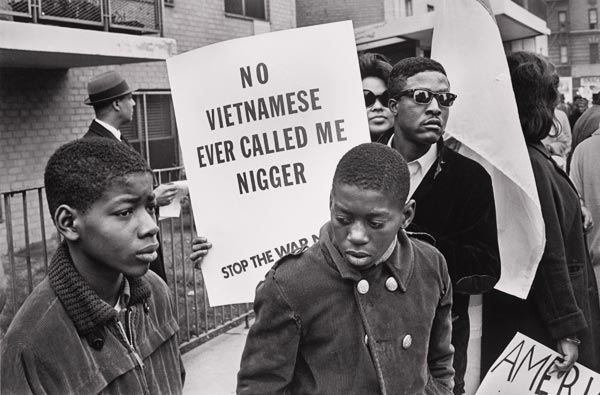
It reminds me of what Muhammed Ali said at the close of the Beaver Cleaver era when he was stripped of his heavyweight title by this conspiracy. When asked by a reporter why he had refused to fight in Vietnam, he replied, “Ain't no Vietnamese ever called me nigger!” and he pointed squarely at the reporter, “You my enemy!”... and so the slow, grueling evolution of individual awareness inches on.

The two parties have no reason to confront themselves except in the manufactured form of their own mutually profitable sitcom, and the canned laughter echoes in a make-believe world which must somehow meet the dire exigencies that loom when the T.V. is turned off.

A new Muhammed Ali is needed in the political world – a new minority in this rigged “adversarial” production – this reality show; one where the individual confronts his own real-world needs in an expanding era of diverse, global competition. This competition is yet conceived to be on the battlefield of ideals – a manufactured and inhuman masquerade for those who unwittingly commit to a structure whose priority is to maintain control. Ideals? Whose ideals? Out-dated relics whose rhetoric has changed little since the Holy Roman Empire? They still invoke God (or Allah) for their small purposes – small because their priority is the maintenance of personal power and they still have not weighed the value of human lives against that concern.

Little Alexanders and Napoleons -- little human parodies of grandiosity -- still peer from behind the grinning masks of many politicians and only our recent expanding diversity keeps them at bay. But diversity needs voices more than two sides of the same coin – a need which surely precipitated the election of Obama – yet the rhetoric continues unabated by either party. We are certainly the victims of our own gullibility when demagoguery suffices for plain talk. What does the future hold for an ever-increasingly diverse population whose choices have been limited – by their own proxy – to only two outlets? Who will image this catalyst of change that says, “You my enemy!”? One thing is sure: It won't be a Republican or a Democrat.

It is as Faust remarked to the Devil upon questioning his motivations, “Now, I perceive your worthy occupation:/ You can't achieve wholesale annihilation/ And now a retail business you've begun!” and the Devil replied: “And truly thereby nothing much is done!” This is the perspective of one who has power, but whose power seems never enough to secure its position for fear of its loss. And our politicians will concede only what they are forced to concede by such recognitions. But it is also a reminder: How much can a government do for its citizens when its primary focus is the maintenance of itself?


Evan is an artist, poet, and long-time student of Carl Jung. He is the author of "A Mid-Life Perspective: Conversations with the Unconscious," an epic poem of psychic development in the second half of life inspired by Goethe's Faust. He makes a living as a contractor in the Richmond, Virginia. 

Thursday, July 22, 2010

Party Politics from a Psychological Perspective


by Evan 

Among human concerns, politics is a vital one – it governs the way we approach our lives in a most personal way; not only the way we relate to ourselves, but the group we most relate to. How we conceive these relations is part of the foundation upon which our realities are based. It should be a vital concern to inspect these foundations closely; for these relations just happen – and not until they are consciously considered can they be changed....

“Hence the god, when he began to put together the body of the universe, set about making it of fire and earth. But two things alone cannot be satisfactorily united without a third; for there must be some bond between them drawing them together.” 

So wrote Plato in his Timaeus in the fourth century B.C. – an intuitive illustration of the way people have long perceived the dynamic forces of life. 

To see how such ideas apply to party politics, read with me as the noted Swiss analyst, C.G. Jung, reflects upon this philosophical notion: “The number one claims an exceptional position, which we meet again in the natural philosophy of the Middle Ages. According to this, one is not a number at all; the first number is two. Two is the first number because, with it, separation and multiplication begin, which alone make counting possible. With the appearance of the number two, another appears alongside the one...” 

As Jung goes on to explain, this results in opposition and conflict: “Also associated with the number two is the idea of right and left, and remarkably enough, of favorable and unfavorable, good and bad.” But as Plato observed, there is a “bond drawing them together.” Jung continues: “The One will not let go of the Other because, if it did, it would lose its character; and the Other pushes itself away from the One in order to exist at all. Thus there arises a tension of opposites between the One and the Other. But every tension of opposites culminates in a release, out of which comes the “third.” In the third, the tension of opposites is resolved and the lost unity is restored.”

***********
Similarly, if we look round to see where the two-party system has landed us, an analogy begins to emerge. The close presidential elections of 1960 (49.7% to 48.6%), 1968 (43.4% to 42.7%), 1976 (50.1% to 48%), 2000 (48.38% to 47.87%), and 2004 (50.7% to 48.3%) appear to express a division which may be seen in terms of energy. Frequent attempts by the two-party system to keep a third party off the ballot in many states, the stagnation Congress represents as a result of such division, and the ineffectiveness of government in providing the individual with basic protections all conform to a general trend. 

Of course, no analogy can make it to first base in the mind of a modern reader without scientific validation, and the laws of energy point in this direction. The principle of equivalence states that for every action there is an opposite and equal reaction. The law of entropy states that, in an energic system, differences in intensity are gradually reduced to an even temperature, whereby any further change is prohibited. This is how energy works and it is as applicable to social dynamics as it is to quantum physics – or even political processes, for as Jung writes, “The psyche, too, can be regarded as such a relatively closed system, in which transformations of energy lead to an equalization of differences.”

These transformations have been described by Jung in his eighth volume, and one more quote from it (the last – I promise!) pushes the analogy further: “These functions are based on the principle of the exclusion of the inappropriate, or unsuitable, which might bring about a deviation from the chosen path. The elements that “belong” are left to a process of mutual equalization, and meanwhile are protected from disturbing influences from outside. Thus after some time they reach their “probable” state, which shows its stability in, say, a “lasting” conviction or a “deeply ingrained” point of view, etc. How firmly such structures are rooted can be tested by anyone who has attempted to dissolve such a structure, for instance to uproot a prejudice or change a habit of thought.”

You can see now where the analogy is headed: for this tension of opposites to be  resolved and for change to occur, a third viewpoint is required.

Webster's dictionary defines democracy as: “Government exercised either directly by the people or through elected representatives.” The popular vote was invalidated by the 2000 election, and our representatives are elected – but not unless they are first approved by the two parties. Our representatives are elected by the parties, and that is who they represent. Who is representing us? I think we will have to find an independent party for that.

Evan is an artist, poet, and long-time student of Carl Jung. He is the author of "A Mid-Life Perspective: Conversations with the Unconscious," an epic poem of psychic development in the second half of life inspired by Goethe's Faust. He makes a living as a contractor in the Richmond, Virginia.  The illustrations above are his.

Wednesday, April 21, 2010

NYC Independent Youth Speak on Behalf of Nonpartisan Elections at Brooklyn Charter Revision Hearing 4.20.10


NYC Independent youth speak out on behalf of nonpartisan elections at NYC Charter Revision Commission public hearing at St. Francis Community College, downtown Brooklyn, April 20, 2010. Speakers included Bryan Puertas, Liza Garcia, Francelli Chapman, and Tracy Thomas. Extended dialogue with Commissioners Chairman Matthew Goldstein, Hope Cohen, and Kathryn Patterson. St. Francis College, Brooklyn, April 20, 2010

Tuesday, April 13, 2010

VIDEO: Live Streaming Tonight 6pm: NYC Charter Revision Hearing from Staten Island

Bronx Officials and Activists Call for Nonpartisan Elections at Charter Revision Commission Public Hearing 4/12/10

There was scant press coverage of last night's NYC Charter Revision Commission public hearing at Hostos University in the Bronx, however here's a Daily News piece including a video from Erin Einhorn.

And while we're on the subject, you can see a video library of statements from independent leaders and activists in support of nonpartisan elections at Hankstertube Playlist NYC Charter Revision 2010.

Watch Tuesday’s Charter Commission Hearing Live
If you cannot attend Tuesday’s Commission hearing in Staten Island, at McKee High School, you can watch it live via Webcast, right here. Check back at 6pm Tuesday.

Tonight's hearing at McKee High School seems to be a response to the request by NYC youth

Sunday, February 28, 2010

JP Avlon -- Photo-op centrism is not enough: Can centrists and independents come together on systemic policy issues?

A round roundup of what's on the minds of independent pundits and voters from Florida to Massachusetts to New York. Starting out with a little ditty from newly acquisitioned Daily Beast/former New York Sun journalist John P. Avlon (John P. Avlon is senior political columnist for The Daily Beast and author of the new book "Wingnuts: How the Lunatic Fringe is Hijacking America.")


Avlon says in his CNN post yesterday "Why centrist voters are fed up":

But photo-op centrism is, of course, not enough. It must be followed by substance. To really change the culture of Washington, we need to change the rules that reinforce this predictable partisanship.
The quickest policy cure would be to change the rigged system of redistricting that creates congressional 'safe seats' and replaces competitive general elections with closed primaries, where party activists reign supreme. Nonpartisan redistricting and open primaries would reward politicians who reach across the aisle, and would empower independent voters.
Can centrists and independents come together on these systemic policy issues? I think so! And because independents do (NOT) = centrists, we have a shot. (-NH)

And while you're here on The Hankster, don't skip Florida's redistricting issues, or a possible new Massachusetts independent party.

And as for New York -- what's going on in the Empire State? Well, the first independent mayor of New York City (Michael Bloomberg), backed by the NYC Independence Party county organizations (When does the county count more than the state? HINT: When the NYC IP is involved...) (Full disclosure, I'm the Treasurer of the Queens County Executive Committee of the Independence Party of New York, and a long-time activist for independent politics) gave money to the NY State Independence Party, which gave money to a local Repub operative who gave money to ____? Where will it all end? Hopefully, in the hands of the people.

Not really sure about this. But NY media is really excited. And a note about the "other" third party, the Working Families Party, which (having played a major role in the election of the "other" city-wide offices City Comptroller (former Queens City Councilmember John Liu) and City Advocate (Betsy Gotbaum's old job) is now under attack from the official election regulation bureaucracy. Small wonder...

Read on!

INDEPENDENT VOTERS
FLORIDA
MASSACHUSETTS
NEW YORK

Friday, November 13, 2009

Talk Talk: Independents, Organized


Sunday, Nov. 8, 2009


Every week CUIP's president Jacqueline Salit and strategist/philosopher Fred Newman watch the political talk shows and discuss them. Here are excerpts from their dialogues compiled on Sunday, November 8, 2009 after watching selections from "This Week with George Stephanopoulos" and "Hardball with Chris Matthews."


Newman: Because I don’t know what “it” is and I don’t know what “power” is in this context. Look, you have what you have. That’s what you have. And you organize what you have.

Salit: Yes.

Newman: When I say I don’t know what “it” is, I mean that it’s still very embryonic, very new. And it’s emerging at the rate that it’s emerging at. And it does the things that it does. So, when you say that they’re looking for trends, that’s not quite accurate. They’re looking for trends which they take to be comprehensible and possible, but only from a two-party point of view.

Salit: True enough.

Newman: So, they’re not looking at trends at all. They won’t look at our trends. They’re not even looking at trends in the same way that we consider trends. We know that there are two dominant major parties. But we also know that there’s something else going on. It’s a “becoming,” if you will.

Salit: Yes.

Newman: And they don’t consider that when they analyze what the elections are all about. It’s all swing, swing, swing, swing. Last year they swung one way. This year they swung another. Well, what if what you’re calling a “swing” is the emergence of a new kind of political movement?


Read Talk/Talk in its entirety here.

Wednesday, November 11, 2009

TODAY'S NEWS HEADLINES for INDEPENDENT VOTERS 11/11/09


ABOVE THE FOLD

  • Independents are a Sleeping Giant (By Alex Hammer, The Moderate Voice) Twenty-six per cent of Mayor Bloomberg’s re-election votes in New York City this past week — well over 140,000 votes — came on the Independence line and not on the Republican line. Think about that for a minute, and why the national media keep it “hush hush". [Alex Hammer is an independent candidate for Gov of Maine]

PHOTO: NYC Independence Party members Ramon Pena, Vito Serra and Yvonne Lee at the City-Wide meeting at Grand Hyatt in Manhattan the Sunday before Election Day.

INDEPENDENT VOTERS

  • Going To A Party (By Raynard Jackson, Afro.com - Balt-Wash) Political parties now face the same fate.  They, by their very existence, tend to be static and bureaucratic.  If you believe like I believe, then you can join my party.  But, what these parties are missing is the fact that people now want choices and these choices are constantly changing.
  • The end of independents (By Carl Golden, NJ.com)  NOTE: Carl Golden is a Republican strategist who worked as Gov. Kaine's press secretary (hence the wishful thinking of the title....)
  • Republicans Narrowly Lead Democrats in 2010 Vote (Holly Bailey, Newsweek/The Gaggle) The reason for the slight GOP edge: Republicans now have a 22 point lead over Democrats among so-called independent voters.
  • Republicans Edge Ahead of Democrats in 2010 Vote - Registered voters prefer Republicans for the House, 48% to 44% (by Jeffrey M. Jones, Gallup) Independents are increasingly coming to prefer the Republican candidate for Congress, and now favor the GOP by 22 points.
  • Republicans pass Democrats: Swing '09-A 21-point shift in sentiment among independents underlies the swing. (by Mark Silva, Chicago Tribune/The Swamp)
  • Pelosi plays whack-a-mole on health care (By Gloria Borger, CNN Senior Political Analyst) Indeed, while the two political parties continue to shrink (with the GOP almost at oblivion, at nearly an all-time low of 24 percent), the independents may be the only healthy political entity in the nation.
  • Indie voters nix O's Rx (By GEOFF EARLE, NY Post)
  • The most important number in politics today (Chris Cillizza, Washington Post/The Fix) 44: That's the percentage of independent voters who told Gallup they would advise their Member of Congress to vote against a health care bill while just 22 percent said their elected official should support it...
  • Now, GOP Has The Numbers-Democrats Have Some Crunching To Do After Republicans Turn Their 2008 Deficits Into 2009 Gains (by Amy Walter, National Journal Online) Democrats need to do more than just turn out those Obama "surge" voters of 2008. They need to do as well as he did among those more traditional groups like independents and whites, too.


THIRD PARTIES


GOVERNORS RACES


BLOOMBERG 09
  • Big Jewish Turnout For Bloomberg (by Adam Dickter, The Jewish Week) Three-quarters of Jewish voters supported Mayor Michael Bloomberg in his narrow third-term victory in last week’s election, according to a New York Times exit poll. If accurate, that would be a sharp increase from the 53 percent of the Jewish vote the independent mayor garnered in 2005, when he was a Republican running against Democrat Fernando Ferrer.
  • Christine Quinn Stands Pat (By Azi Paybarah, NY Observer) “She can’t just continue to stay in the mayor’s shadow,” said Kathy Wylde, president and CEO of the Partnership for New York City. Speaking about the bill, which her group opposes, Ms. Wylde said the question is whether Ms. Quinn “can now steer a course independent of Bloomberg.”

LOCAL RACES

Friday, August 28, 2009

Join The Hankster on Sunday night 8:30pm NY Time with Poli-Tea


I hope you will tune in to a special BlogTalkRadio show this Sunday at 8:30pm Eastern Time, a conversation with Poli-Tea and The Hankster


Poli-Tea author Damon Eris, independent political blogger, talks with The Hankster about independent and third party politics, the rise of independent voters in the face of an entrenched political duopoly, and what it all means to American politics circa 2009 and beyond.


Click here to sign in to the show http://www.blogtalkradio.com/hankster/2009/08/31/Poli-Tea-Third-Party-Opposition-to-the-Two-Party-System You'll be able to access the call online and make comments, ask questions and give your opinion!

And you can also call in between 8:30 and 9:00pm Eastern Time at (347) 884-8634!

Talk or not, but please join us for the converation!

It's BlogTalkRadio!

Thanks!
Nancy